
The Renters’ Rights Act 2025: a guide for landlords and letting agents

Royal Assent
27th October 2025
Council Powers
27th December 2025
Main Legislation
1st May 2026
Information Sheet Deadline
31st May 2026
Landlord Database
Late 2026

What the Renters’ Rights Act means for your properties

The Renters’ Rights Act removes the legal framework most landlords have operated under since 1988. From 1st May 2026, the rules on tenancies, evictions, rent increases, and compliance are different.

The Assured Shorthold Tenancy (AST) is abolished. Section 21 no longer exists. Every tenancy becomes periodic from day one. And new obligations around rent increases, tenant notice, and the landlord database mean the way you manage your properties needs to change too.

Section 21 is abolished

A tenancy ends when your tenant gives notice, or when you obtain a court order under Section 8. Understanding valid grounds for possession becomes essential.

End of the AST

Every tenancy in England becomes an Assured Tenancy, periodic from day one – no fixed terms, no automatic end dates. Existing fixed-term tenancies convert automatically on 1st May 2026, regardless of how much time remains.

“One out, all out”

In a joint tenancy, any one tenant can serve two months’ notice and end the tenancy for everyone, including occupants who want to stay. When that notice expires, the original tenancy is gone. You then need to negotiate and sign a fresh agreement with anyone remaining. For HMO operators, room-only tenancies avoid this entirely.

Section 13 increases only

Rent can only go up by serving a Section 13 Notice: two months’ notice, once a year. Every rent review clause and CPI-linked uplift in your existing agreements becomes invalid from 1st May. If a tenant disputes an increase, they can take it to the First-tier Tribunal at no cost to them.

Pets

Blanket “no pets” bans in listings are no longer permitted. Tenants have a right to request a pet in writing; you may only refuse on reasonable grounds.

Landlord database & Ombudsman

Every landlord in England must register on a new national database (expected late 2026) and join the Private Rented Sector Ombudsman. Fines from £7,000 to £40,000 for non-compliance.

Rent in advance banned

You can only collect the first month’s rent, and only after the tenancy agreement has been signed. This applies to every tenant, including students and those who don’t meet standard referencing thresholds. You cannot ask for several months upfront as a condition of the tenancy, even informally.

12-month protected period

For the first 12 months of any new tenancy, you cannot evict a tenant in order to sell the property or move in. After that period, both grounds become available, but require four months’ notice. You also cannot re-let or market the property for 12 months after using either ground.

Action required by 31st May 2026: RRA Information Sheet

You must serve the Government’s RRA Information Sheet to all existing tenants by 31st May 2026. Attaching the PDF to an email counts, but sending a link to the PDF does not. Failure carries a maximum £7,000 penalty for a first offence.

COHO’s tenant comms panel lets you send and record acknowledgement in one place.


New tenancy agreements, ready to use inside COHO

From 1st May 2026, the Assured Shorthold Tenancy is no longer valid. Every new tenancy in England needs a compliant Assured Tenancy Agreement. COHO now includes three versions, written specifically for the post-RRA framework. All have been reviewed by a UK property solicitor, and are free on every active COHO subscription.
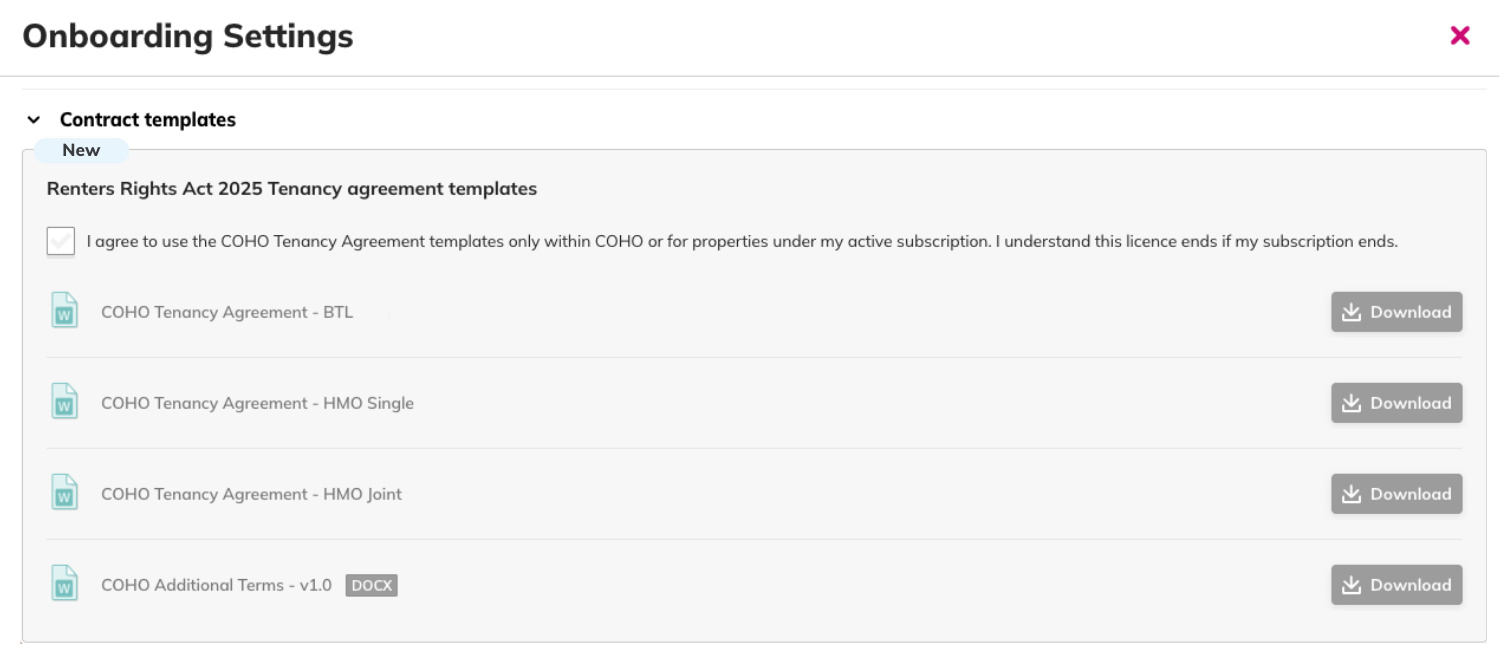
COHO Renters Rights' Act - Tenancy Agreements

Select the version for your property type, customise if needed, and save as a reusable template. Tenancy details including names, addresses, rent and start date fill in automatically from the data in your account. All have been reviewed by a UK property solicitor and are free on every active COHO subscription. Read more about our RRA-compliant Assured Tenancy Agreements.

New to COHO? The agreements are waiting for you the moment you sign up.

What we’ve built for the Renters’ Rights Act, and what’s coming soon in COHO

Live now

Tenant communications panel

Under the new rules, what you said and when you said it can become legally significant. The comms panel brings together messages, compliance documents, contracts, and credit control notices into a single timeline for each tenant so nothing is scattered across email and WhatsApp.

Coming soon

Room rate prompts

Under the RRA, you cannot accept a tenancy for more than the advertised room rate. COHO will add a prompt when the rent you enter on a tenancy exceeds the rate you listed. We’ll also update the COHO listing site to make it easier to accept offers below the advertised price.

Live now

Periodic tenancies as default

All new tenancies created in COHO now start as periodic from day one, matching the new legal reality. You’re no longer working against system defaults that assumed fixed terms.

Coming soon

Rent increase insights

COHO will bring in local market rate data before you set a new rent amount, so you have evidence to support the increase if it’s ever questioned by a tenant.

Coming soon

RRA-compliant move-in monies

The rules on when you can request rent and how much have changed significantly. COHO is separating the point at which you define move-in monies (for the agreement) from the point at which you request payment. COHO will warn you when you’re about to request rent before the tenancy agreement has been signed, so you can’t fall into non-compliance by accident.

Expert guidance, straight from the people who know


Webinar: The Renters’ Rights Act explained

In this COHO webinar, Julie Ford, specialist adviser and founder of Lettings Advice Service, explains what the new legislation means for property managers, agents and landlords. Covering the key updates introduced by the Act, what they mean for day-to-day management, and how to prepare and stay compliant.

Property management software for the Renters’ Rights Act

The Renters’ Rights Act changes how you manage tenancies, collect rent, handle disputes and stay compliant. These are the COHO features that help you do all of it.

Keep on top of periodic tenancies

Without fixed end dates, there is no natural prompt to review a tenancy. Rooms can sit on the wrong terms, renewals get missed, and things drift. COHO keeps your full portfolio in one view, every room, every tenant, every agreement, so you always know where things stand.

Collect rent without the chasing

Rent collection through GoCardless runs automatically in the background. Every payment is logged, every failure flagged. When a Section 13 rent increase needs documenting, the records are already there.

A record of every key communication

Under the new rules, what you said and when you said it matters more than ever. Message tenants directly in COHO and every exchange is logged and timestamped. Notice acknowledgements, inspection reminders, rent increase notifications. Everything in one place, not scattered across email and WhatsApp.

Compliance documents in one place

Gas safety certificates, EICRs, HMO licences, insurance documents, COHO keeps them organised and accessible. When the landlord database goes live, you will not be scrambling to find what you need.

Find tenants worth keeping

Under periodic tenancies, a tenant who leaves after two months costs you significantly more than before. COHO’s compatibility matching helps you find tenants who are genuinely suited to the property and the household, reducing the turnover that the new rules make more expensive.

The Renters’ Rights Act is coming. COHO is ready.

New legislation. New agreements. New rules on evictions, rent increases and compliance. It is a lot to take in. Set up a demo account and see how COHO helps you manage it, before 1st May arrives.