
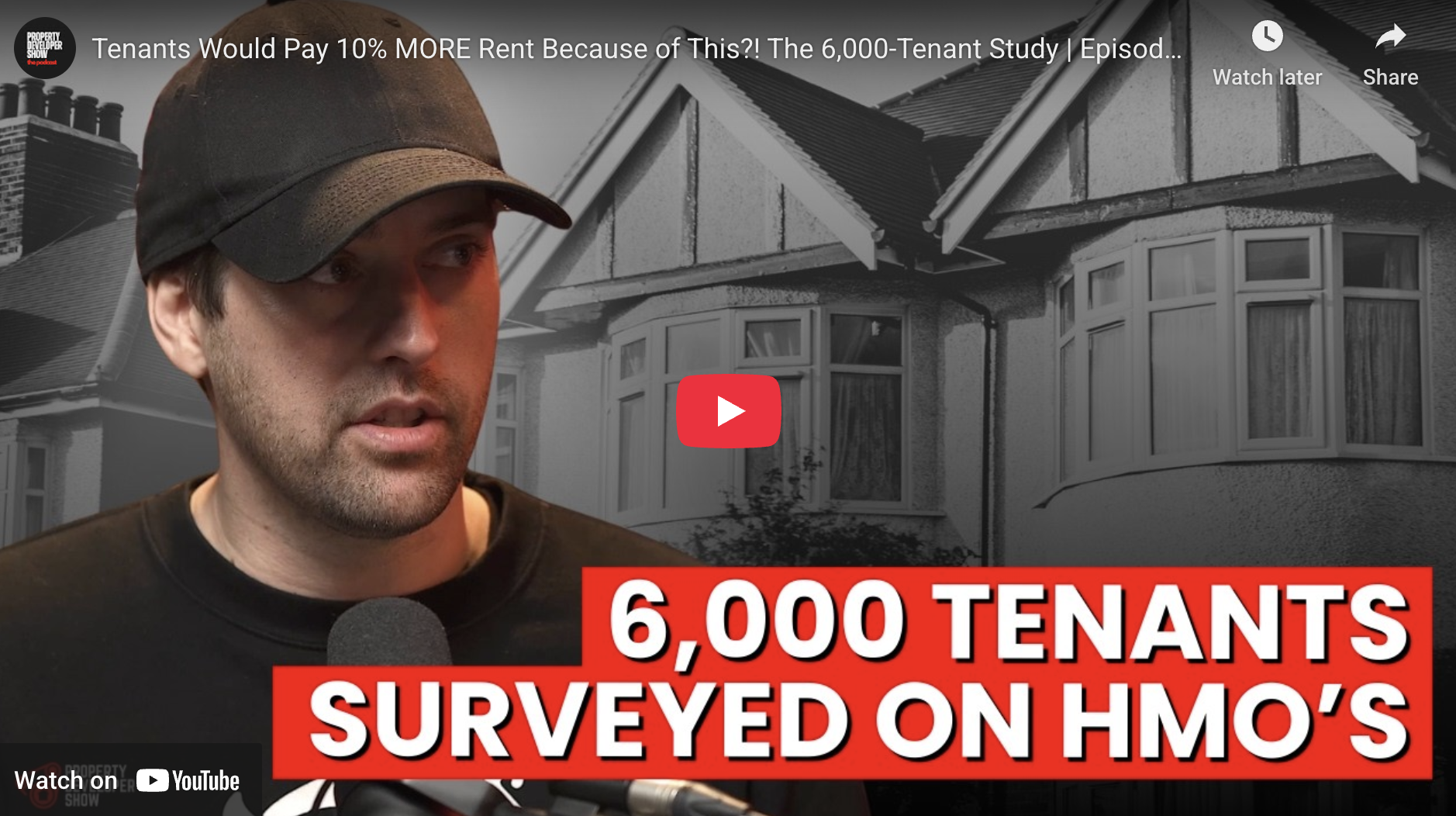
Data from 6,000 tenants reveals what actually drives returns in shared living, and it’s not the kitchen you put on Instagram.
Based on a conversation between Vann, founder of COHO, and the Property Developer Show podcast.
There’s a widely held belief in the HMO world that the renovation is what makes the money. Bigger kitchens, better bathrooms, Instagram-worthy interiors. And while none of that hurts, the data tells a more nuanced story.
In a recent episode of the Property Developer Show podcast, Vann, founder of COHO, the property management platform used by HMO landlords and letting agents across the UK, laid out a case for a fundamentally different approach to running house shares. One rooted not in how the property looks, but in how the people inside it feel.
What followed was one of the most data-rich, experience-led conversations about HMO investing you’re likely to hear, backed by the largest tenant study ever conducted in UK shared living.
Listen to the full episode here.
The Renovation Trap: Style Without Substance
Vann doesn’t mince words about the industry’s obsession with renovation aesthetics. Having lived in an HMO himself, one that, by his own admission, wouldn’t win any design awards, he experienced firsthand that the physical property was only part of the equation.
“I lived in an HMO and I had an incredible experience, but mine did not look cool. My parents came to the house once and they were like… is this it? I’ll leave my shoes on.” — Vann, founder of COHO
The point isn’t that renovations don’t matter. They do, they get you noticed on listing sites and they make great social media content. But Vann draws a sharp distinction between what gets a property seen and what makes it perform.
“People generally focus on two things: the economics and the design of the property itself. What they’re not looking at is the experience.” — Vann, COHO
He draws a comparison to Apple, a company that succeeds not because its products look nice, but because it designs the entire experience around the user, including how you feel about yourself as a user. The landlords who are pulling ahead, Vann argues, are doing the same thing: thinking about shared living from the tenant’s perspective, not just from a spreadsheet.
The Data: 6,000 Tenants and What They Actually Want
COHO conducted a study of 6,000 tenants, the largest ever in UK shared living. The findings challenge the dominant narrative that HMO tenants are budget-driven and take whatever they can get.
“Over 50% of the people said they would pay 10% more rent to get a house that was more compatible, socially compatible, to live with people they get on with. There’s money literally just being left on the table for that experience side of it.”— Vann, COHO
Of the remaining tenants who said they wouldn’t pay more, roughly half said they would if they could afford it, they simply didn’t have the extra budget. The segment that was genuinely uninterested in compatibility was small, and Vann poses a pointed question about them:
“The ones who are not interested at all, how do you think they are as tenants? And how do you think they are with the people around them?” — Vann, COHO
The implication is clear. The tenant problems that dominate landlord forums, missed rent, damage, antisocial behavior, and constant turnover, are often symptoms of a selection process that optimises for references and deposits rather than compatibility and intent.
The Business Case: Why Experience Drives Returns
Vann frames the experience-first approach not as a soft, feel-good philosophy but as a hard commercial advantage. The business logic stacks up across multiple dimensions:
- Longer tenancies. Tenants who feel compatible with their housemates stay longer, meaning fewer voids, fewer changeovers, and fewer viewings.
- Better property care. When tenants have a sense of social responsibility to the group, they treat the house better. Nobody wants to be the person dragging down a household they enjoy living in.
- Higher rent tolerance. The 6,000-tenant study shows over half would pay a 10% premium for social compatibility, revenue that most landlords are currently leaving on the table.
- Fewer management headaches. The complaints that fill HMO landlord groups, problem tenants, disputes, and damage, reduce significantly when the incoming tenant is screened for fit, not just financial standing.
Vann highlights Caroline Pattinson as an example of a landlord who gets this right. Her focus on one of her recent projects wasn’t the specification of the kitchen or the en-suites; it was the bin management. Identifying where friction occurs in the daily living experience and designing it out before it becomes a problem.
“What a lot of people don’t understand is how much extra money there is to be made by having that mentality.”— Vann, COHO
The Renters’ Rights Act Factor
The regulatory landscape has shifted the calculus further. Under the Renters’ Rights Act, removing problem tenants is harder and more costly than ever. Vann sees this as making the case for upfront tenant curation even stronger:
If the penalty for getting it wrong has gone up, the value of getting it right at the front door increases proportionally. Landlords who rely on “as long as they pass a reference, I don’t care” are exposed to a regulatory environment that no longer lets them course-correct easily. Those who invest in understanding why someone is moving in and what they’re looking for are building in resilience.
Loneliness, Connection, and the Bigger Picture
The conversation goes deeper than investment returns. Vann points to data from the Harvard Study of Adult Development, a 75-year longitudinal study, which found that connection with others is the single biggest factor in longevity, outranking smoking, drinking, and obesity.
“Loneliness is the biggest killer. You see that with older people time and time again, a spouse dies, they just drop like a rock. The human brain is not built for being on your own the whole time.” — Vann, COHO
COHO’s own data backs this up in a UK-specific context. Their loneliness study, which reached the front page of BBC News, has shown how the cost of living crisis compounds isolation and how shared living, done well, can be a genuine intervention. Vann sees HMO landlords as providing a service to the country that goes well beyond housing supply, touching mental health, community resilience, and social connection.
There’s also a growing demographic trend. COHO’s data shows shared living uptake among the over-40s is rising, and there’s demand for over-60s house shares with virtually no supply. Single occupants in large family homes, often elderly people rattling around in four- and five-bedroom properties, represent both a housing efficiency problem and a human one.
The Airbnb Moment for HMOs
Vann draws parallels to two platform shifts that have already happened in adjacent industries.
Airbnb took the slightly odd idea of renting a room in a stranger’s home and turned it into a mainstream, premium experience. Before Airbnb, short-term letting was a cottage in Wales found through a newspaper. After it, millions of people default to Airbnb over hotels because they want something that feels more personal.
WeWork did the same for shared offices. Before WeWork, being in a shared workspace was mildly embarrassing; it implied you couldn’t afford your own office. WeWork reframed it as a premium, creative choice. People paid more to be surrounded by interesting, like-minded professionals.
“We’ve not yet seen either of those things happen in HMOs. Yet everything points towards that’s what tenants are looking for, if it exists.” — Vann, COHO
The missing ingredient, Vann argues, is the ability for tenants to see who they’d be living with before they commit. Current listing platforms show gender and a loose age range at best. As Vann puts it: if someone told you that you’re going on holiday with three males and one female aged between 22 and 48, you’d hesitate. But if you could see their profiles, interests, and personalities, you might be all in.
What COHO Is Building
COHO already allows tenants in a property to optionally share profiles, interests, jobs, bios, and photos that incoming prospective tenants can see before they apply. The uptake has been high, particularly among newer tenants who recognise the value of self-selection: show who you are, and you’re more likely to attract someone compatible.
In 2026, COHO is stepping this up significantly. Vann describes a matching algorithm where tenants answer a few short questions about how social they want the household to be, how important cleanliness is, and their lifestyle preferences, and the platform recommends compatible properties. He half-jokingly calls it “Tinder for groups of housemates.”
“I genuinely believe that we’re going to see a higher take-up in shared living by a higher-tier tenant, which I think is really exciting for the industry.” — Vann, COHO
Beyond the tenant-facing side, COHO provides end-to-end property management software for HMO landlords and letting agents: finance tracking, compliance management, maintenance, tenant onboarding, portal listings, and profitability analytics. The platform supports operators from single properties to portfolios of 3,000+ units.
The Political Opportunity Landlords Are Missing
One of the most striking parts of the conversation is Vann’s analysis of the political landscape around HMOs. He uses a PESTLE framework to argue that most landlords only look at the economic lens, do the numbers stack?, while ignoring the political, social, and environmental dimensions.
Councils currently resist HMOs because all they see are complaints. As Vann notes, nobody phones the council to say, “That HMO next door is a lovely group of people.” The perception problem is real, but it’s also an opportunity.
When Vann gets in a room with politicians, the conversation shifts fast:
- Green Party / Net Zero: Doubling the population in an HMO halves the per-person carbon cost of living. Shared housing is one of the most environmentally efficient housing models available.
- University towns / Brain drain: Affordable, well-managed shared housing in central locations keeps graduates in the local economy instead of pricing them out.
- Housing efficiency: The UK doesn’t necessarily have a housing shortage; it has a housing efficiency problem. Demand for one-beds massively outstrips supply, while four- and five-bed houses sit underoccupied. Well-run HMOs are a direct solution to that mismatch.
“I think where the numbers on returns for HMOs currently is, that is based on an environment that’s extremely hostile and people are basically still able to make it work. But I think there’s blue skies ahead.” — Vann, COHO
What HMO Landlords Should Do Now
The thesis is clear, and the data supports it. Here’s what forward-thinking landlords can start doing today:
- Screen for fit, not just finances. Ask tenants why they’re moving in. Understand what they’re looking for socially. Some landlords now won’t do a viewing unless they feel the person is right for the household.
- Design for daily friction, not just photos. Think about bin management, cleaning rotas, and shared space etiquette. Tenant satisfaction is found in the boring operational details.
- Let tenants do the selling. Consider involving existing tenants in viewings. If the household culture is right, they’re your best sales team.
- Use tools that support the experience. A spreadsheet and an Openrent listing won’t get you there. Platforms like COHO are built specifically for this end-to-end approach.
- Think about who’s next. The over-40s market is growing. The over-60s market is untapped. Divorced professionals, empty nesters, and remote workers, these are demographics actively seeking connection, and they have a budget.
The Bottom Line
HMOs already perform well as an investment vehicle. But the current returns are built on a hostile regulatory environment, a negative public perception, and a tenant selection process that most landlords treat as a checkbox exercise. Every one of those factors is a constraint that’s suppressing what the asset class can actually deliver.
The landlords who will lead the next phase of shared living are the ones who see their properties not as spreadsheet rows but as communities. The data from 6,000 tenants is telling them exactly what the market wants. The question is whether they’re listening.
As Vann puts it:
“These people are doing a huge service to the country. They’re what is going to get us through not only the housing crisis, but also this massive rise in mental health costs. It just needed a catalyst.” — Vann, founder of COHO
This article is based on a conversation between Vann, founder of COHO, and the Property Developer Show podcast. COHO is an end-to-end property management platform for HMO landlords and letting agents.
Data from 6,000 tenants reveals what actually drives returns in shared living, and it’s not the kitchen you put on Instagram.
Based on a conversation between Vann, founder of COHO, and the Property Developer Show podcast.
There’s a widely held belief in the HMO world that the renovation is what makes the money. Bigger kitchens, better bathrooms, Instagram-worthy interiors. And while none of that hurts, the data tells a more nuanced story.
In a recent episode of the Property Developer Show podcast, Vann, founder of COHO, the property management platform used by HMO landlords and letting agents across the UK, laid out a case for a fundamentally different approach to running house shares. One rooted not in how the property looks, but in how the people inside it feel.
What followed was one of the most data-rich, experience-led conversations about HMO investing you’re likely to hear, backed by the largest tenant study ever conducted in UK shared living.
Listen to the full episode here.
The Renovation Trap: Style Without Substance
Vann doesn’t mince words about the industry’s obsession with renovation aesthetics. Having lived in an HMO himself, one that, by his own admission, wouldn’t win any design awards, he experienced firsthand that the physical property was only part of the equation.
“I lived in an HMO and I had an incredible experience, but mine did not look cool. My parents came to the house once and they were like… is this it? I’ll leave my shoes on.” — Vann, founder of COHO
The point isn’t that renovations don’t matter. They do, they get you noticed on listing sites and they make great social media content. But Vann draws a sharp distinction between what gets a property seen and what makes it perform.
“People generally focus on two things: the economics and the design of the property itself. What they’re not looking at is the experience.” — Vann, COHO
He draws a comparison to Apple, a company that succeeds not because its products look nice, but because it designs the entire experience around the user, including how you feel about yourself as a user. The landlords who are pulling ahead, Vann argues, are doing the same thing: thinking about shared living from the tenant’s perspective, not just from a spreadsheet.
The Data: 6,000 Tenants and What They Actually Want
COHO conducted a study of 6,000 tenants, the largest ever in UK shared living. The findings challenge the dominant narrative that HMO tenants are budget-driven and take whatever they can get.
“Over 50% of the people said they would pay 10% more rent to get a house that was more compatible, socially compatible, to live with people they get on with. There’s money literally just being left on the table for that experience side of it.”— Vann, COHO
Of the remaining tenants who said they wouldn’t pay more, roughly half said they would if they could afford it, they simply didn’t have the extra budget. The segment that was genuinely uninterested in compatibility was small, and Vann poses a pointed question about them:
“The ones who are not interested at all, how do you think they are as tenants? And how do you think they are with the people around them?” — Vann, COHO
The implication is clear. The tenant problems that dominate landlord forums, missed rent, damage, antisocial behavior, and constant turnover, are often symptoms of a selection process that optimises for references and deposits rather than compatibility and intent.
The Business Case: Why Experience Drives Returns
Vann frames the experience-first approach not as a soft, feel-good philosophy but as a hard commercial advantage. The business logic stacks up across multiple dimensions:
- Longer tenancies. Tenants who feel compatible with their housemates stay longer, meaning fewer voids, fewer changeovers, and fewer viewings.
- Better property care. When tenants have a sense of social responsibility to the group, they treat the house better. Nobody wants to be the person dragging down a household they enjoy living in.
- Higher rent tolerance. The 6,000-tenant study shows over half would pay a 10% premium for social compatibility, revenue that most landlords are currently leaving on the table.
- Fewer management headaches. The complaints that fill HMO landlord groups, problem tenants, disputes, and damage, reduce significantly when the incoming tenant is screened for fit, not just financial standing.
Vann highlights Caroline Pattinson as an example of a landlord who gets this right. Her focus on one of her recent projects wasn’t the specification of the kitchen or the en-suites; it was the bin management. Identifying where friction occurs in the daily living experience and designing it out before it becomes a problem.
“What a lot of people don’t understand is how much extra money there is to be made by having that mentality.”— Vann, COHO
The Renters’ Rights Act Factor
The regulatory landscape has shifted the calculus further. Under the Renters’ Rights Act, removing problem tenants is harder and more costly than ever. Vann sees this as making the case for upfront tenant curation even stronger:
If the penalty for getting it wrong has gone up, the value of getting it right at the front door increases proportionally. Landlords who rely on “as long as they pass a reference, I don’t care” are exposed to a regulatory environment that no longer lets them course-correct easily. Those who invest in understanding why someone is moving in and what they’re looking for are building in resilience.
Loneliness, Connection, and the Bigger Picture
The conversation goes deeper than investment returns. Vann points to data from the Harvard Study of Adult Development, a 75-year longitudinal study, which found that connection with others is the single biggest factor in longevity, outranking smoking, drinking, and obesity.
“Loneliness is the biggest killer. You see that with older people time and time again, a spouse dies, they just drop like a rock. The human brain is not built for being on your own the whole time.” — Vann, COHO
COHO’s own data backs this up in a UK-specific context. Their loneliness study, which reached the front page of BBC News, has shown how the cost of living crisis compounds isolation and how shared living, done well, can be a genuine intervention. Vann sees HMO landlords as providing a service to the country that goes well beyond housing supply, touching mental health, community resilience, and social connection.
There’s also a growing demographic trend. COHO’s data shows shared living uptake among the over-40s is rising, and there’s demand for over-60s house shares with virtually no supply. Single occupants in large family homes, often elderly people rattling around in four- and five-bedroom properties, represent both a housing efficiency problem and a human one.
The Airbnb Moment for HMOs
Vann draws parallels to two platform shifts that have already happened in adjacent industries.
Airbnb took the slightly odd idea of renting a room in a stranger’s home and turned it into a mainstream, premium experience. Before Airbnb, short-term letting was a cottage in Wales found through a newspaper. After it, millions of people default to Airbnb over hotels because they want something that feels more personal.
WeWork did the same for shared offices. Before WeWork, being in a shared workspace was mildly embarrassing; it implied you couldn’t afford your own office. WeWork reframed it as a premium, creative choice. People paid more to be surrounded by interesting, like-minded professionals.
“We’ve not yet seen either of those things happen in HMOs. Yet everything points towards that’s what tenants are looking for, if it exists.” — Vann, COHO
The missing ingredient, Vann argues, is the ability for tenants to see who they’d be living with before they commit. Current listing platforms show gender and a loose age range at best. As Vann puts it: if someone told you that you’re going on holiday with three males and one female aged between 22 and 48, you’d hesitate. But if you could see their profiles, interests, and personalities, you might be all in.
What COHO Is Building
COHO already allows tenants in a property to optionally share profiles, interests, jobs, bios, and photos that incoming prospective tenants can see before they apply. The uptake has been high, particularly among newer tenants who recognise the value of self-selection: show who you are, and you’re more likely to attract someone compatible.
In 2026, COHO is stepping this up significantly. Vann describes a matching algorithm where tenants answer a few short questions about how social they want the household to be, how important cleanliness is, and their lifestyle preferences, and the platform recommends compatible properties. He half-jokingly calls it “Tinder for groups of housemates.”
“I genuinely believe that we’re going to see a higher take-up in shared living by a higher-tier tenant, which I think is really exciting for the industry.” — Vann, COHO
Beyond the tenant-facing side, COHO provides end-to-end property management software for HMO landlords and letting agents: finance tracking, compliance management, maintenance, tenant onboarding, portal listings, and profitability analytics. The platform supports operators from single properties to portfolios of 3,000+ units.
The Political Opportunity Landlords Are Missing
One of the most striking parts of the conversation is Vann’s analysis of the political landscape around HMOs. He uses a PESTLE framework to argue that most landlords only look at the economic lens, do the numbers stack?, while ignoring the political, social, and environmental dimensions.
Councils currently resist HMOs because all they see are complaints. As Vann notes, nobody phones the council to say, “That HMO next door is a lovely group of people.” The perception problem is real, but it’s also an opportunity.
When Vann gets in a room with politicians, the conversation shifts fast:
- Green Party / Net Zero: Doubling the population in an HMO halves the per-person carbon cost of living. Shared housing is one of the most environmentally efficient housing models available.
- University towns / Brain drain: Affordable, well-managed shared housing in central locations keeps graduates in the local economy instead of pricing them out.
- Housing efficiency: The UK doesn’t necessarily have a housing shortage; it has a housing efficiency problem. Demand for one-beds massively outstrips supply, while four- and five-bed houses sit underoccupied. Well-run HMOs are a direct solution to that mismatch.
“I think where the numbers on returns for HMOs currently is, that is based on an environment that’s extremely hostile and people are basically still able to make it work. But I think there’s blue skies ahead.” — Vann, COHO
What HMO Landlords Should Do Now
The thesis is clear, and the data supports it. Here’s what forward-thinking landlords can start doing today:
- Screen for fit, not just finances. Ask tenants why they’re moving in. Understand what they’re looking for socially. Some landlords now won’t do a viewing unless they feel the person is right for the household.
- Design for daily friction, not just photos. Think about bin management, cleaning rotas, and shared space etiquette. Tenant satisfaction is found in the boring operational details.
- Let tenants do the selling. Consider involving existing tenants in viewings. If the household culture is right, they’re your best sales team.
- Use tools that support the experience. A spreadsheet and an Openrent listing won’t get you there. Platforms like COHO are built specifically for this end-to-end approach.
- Think about who’s next. The over-40s market is growing. The over-60s market is untapped. Divorced professionals, empty nesters, and remote workers, these are demographics actively seeking connection, and they have a budget.
The Bottom Line
HMOs already perform well as an investment vehicle. But the current returns are built on a hostile regulatory environment, a negative public perception, and a tenant selection process that most landlords treat as a checkbox exercise. Every one of those factors is a constraint that’s suppressing what the asset class can actually deliver.
The landlords who will lead the next phase of shared living are the ones who see their properties not as spreadsheet rows but as communities. The data from 6,000 tenants is telling them exactly what the market wants. The question is whether they’re listening.
As Vann puts it:
“These people are doing a huge service to the country. They’re what is going to get us through not only the housing crisis, but also this massive rise in mental health costs. It just needed a catalyst.” — Vann, founder of COHO
This article is based on a conversation between Vann, founder of COHO, and the Property Developer Show podcast. COHO is an end-to-end property management platform for HMO landlords and letting agents.